

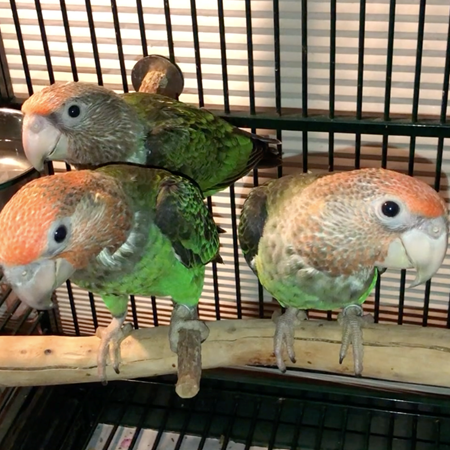
The Brown-necked is the large end of the Poicephalus family and it surprises people who have only met a Senegal or a Meyer's. This is a substantial parrot with a heavy beak, close kin to the Cape Parrot, and it needs housing and handling on a different scale from its small relatives despite sharing their name.
It is bigger than the name suggests
Buyers who come to this species expecting a slightly larger Senegal get a shock. Plan the cage, the perches and the toys around a medium-to-large parrot, not a small one, and expect a beak that can take apart hardwood.
Cape, Brown-necked, Grey-headed
The naming in this group has been argued over for years and the birds are sold under several names, sometimes interchangeably. If the distinction matters to you - and it matters a great deal if you intend to breed - ask the breeder exactly which birds the parents were and what they are registered as. If you are buying a companion, it matters much less than the temperament of the bird in front of you.
Temperament
Calm and steady is the usual description. Brown-necks are less excitable than the small Poicephalus, slower to react, and generally gentle with handling - but they are also more reserved and can be shy with strangers. They bond deeply and quietly rather than clowning.
Noise
Moderate. They have a loud call they use at intervals rather than a constant voice, and they are considerably quieter than a conure of similar size. Not a flat bird, but not a difficult neighbour either.
Health and diet
This group is known to be susceptible to beak and feather disease, so disease testing is a question to ask directly rather than politely. Diet is a pelleted base with fresh vegetables and nuts in measured amounts - they take nuts readily and will overdo them.
Living with one
Twenty-five to thirty years. A large cage, serious chew material, and time out of the cage daily. They are not high-maintenance birds emotionally, but they are physically powerful and a bored one is destructive.
Buying one
Fewer breeders raise these than raise the smaller Poicephalus, so expect to travel or wait. Ask about disease testing, ask exactly what the parents were, and ask when the bird weaned. The breeders listed on this page raise Brown-necked Parrots and can be contacted directly through the site.